Building Safer Spaces for Women in Sport: Insights from the ExerSafe Project
A first look at the findings and ambitions of ExerSafe, a European capacity-building initiative for harassment-free, gender-sensitive sport environments
Why do so many women who want to be physically active end up staying away from gyms, clubs, and sports facilities? The answer, research shows, is rarely a lack of interest. It is far more often a question of safety or rather, the lack of it.
This is the starting point of ExerSafe (Exercise and Physical Activity Safe Environments for Women), a 24-month Capacity Building in the Field of Sport initiative funded by the European Union. The project sets out to understand, and ultimately dismantle, the barriers that keep women from feeling safe and comfortable when they exercise, and to help sport professionals build spaces that are genuinely harassment-free and gender-sensitive. This article presents the problem ExerSafe addresses, summarises what the research tells us, and shares findings from a survey conducted with women in Montenegro.
The Scale of the Problem
Across Europe, women remain significantly less physically active than men. A 2022 European Commission study found that nearly half of women say they never exercise or play sport, and other research suggests more than 60% of women fail to reach the recommended 30 minutes of daily moderate activity. The gap is visible in sports club membership too: women make up only around 44.5% of members in Spain and 29% in France, while in Montenegro men represent close to 70% of athletes across the most popular sports.
Behind these numbers lies a web of practical, social, and cultural barriers, but one factor recurs across the literature: safety. Sport spaces have historically been built around and for men, and this shapes everything from gym layouts to coaching culture to how incidents of harassment are handled, or not.
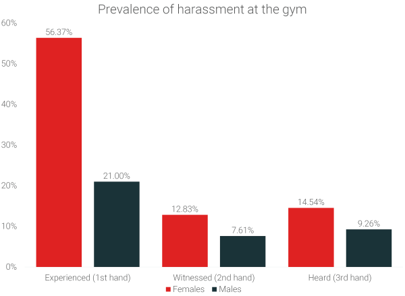
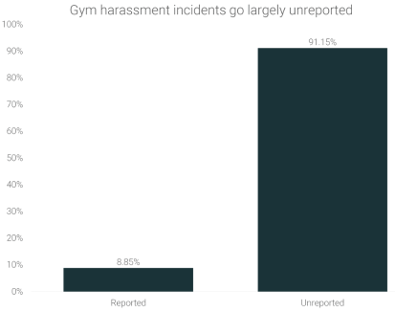
The figures are stark. Studies cited in the ExerSafe literature review found that over half of female gym members report having experienced harassment, and that girls are nearly twice as likely as boys to experience sexual abuse in sport before adulthood. Yet the vast majority of these incidents go unreported. Add to this a sports media and coaching landscape still overwhelmingly dominated by men, sociocultural pressure around body image, and gyms designed without women’s comfort in mind, and it becomes clear why so many women hesitate to walk through the door, or quietly walk back out.
From Diagnosis to Action
ExerSafe was designed to move from identifying these barriers to actively addressing them, through five interlocking objectives:
- Understand women’s needs, analysing what safety and comfort actually mean for women in physical activity spaces.
- Train professionals, creating online learning opportunities for trainers, coaches, and gym staff on building gender-equal environments.
- Set guidelines, producing practical recommendations for stakeholders on gender equality and harassment prevention.
- Build confidence through practice, organising “ExerSafe” sessions that combine sport and education to strengthen women’s confidence, physical literacy, and social connections.
- Test what works, piloting these strategies in real clubs, fitness centres, and sport spaces to measure their impact.
Underpinning all of this is a simple conviction: policies to promote women’s sport and physical activity are only as good as the evidence they are built on. That is why the project’s first step has been listening to research, and to women themselves.
What Women in Montenegro Are Telling Us
As part of this needs-analysis phase, ExerSafe surveyed 111 women in Montenegro about their experiences of physical activity spaces. The results paint a picture that is more encouraging than the wider literature might suggest, but one that still points to clear priorities for action.
The positives:
- Over 82% of respondents are physically active on a regular basis, most exercising three to five times a week.
- A striking 87.2% rate their sense of safety at 8 out of 10 or higher in the spaces where they train.
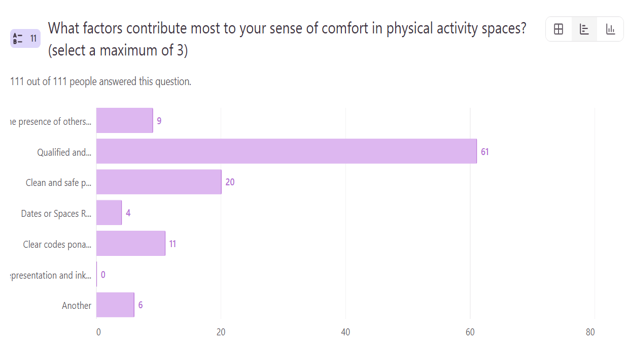
- Women consistently point to the same ingredients for feeling comfortable: qualified and respectful staff (cited by 55% of respondents), clean and secure facilities (18%), and clear codes of conduct against harassment (9.9%).
The remaining gaps:
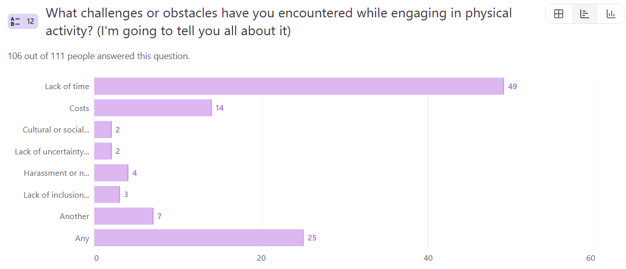
- The most common barrier to participation is not harassment but time (46.2%) and cost (13.2%), a reminder that safety and accessibility go hand in hand.
- Awareness of organisational policies on women’s safety and inclusion remains low: only 13.2% of respondents were aware that such measures existed at all, while 57.6% said no and nearly 30% were unsure.
- Open-ended responses revealed subtler forms of discomfort that don’t always show up in statistics, women describing unease training in male-dominated spaces, or a sense that women’s disciplines, such as rhythmic gymnastics, receive less institutional recognition and support.
Taken together, these findings suggest that many sport spaces in Montenegro are already succeeding in making women feel physically safe, but that trust and comfort could go even further if organisations communicated more clearly about the steps they are taking, and continued investing in the everyday, human factors that women repeatedly identify as decisive: knowledgeable staff, clean facilities, and visible codes of conduct.
Women surveyed were also clear about what would make the biggest difference going forward: accessible pricing (24.3%), flexible scheduling (20.6%), and awareness campaigns (17.8%) topped the list, alongside recurring calls for women-only sessions, childcare support, and beginner-friendly programming, particularly for younger women balancing study or work, and older women seeking low-impact, socially supportive activities.
Why This Matters
These findings echo a wider truth found throughout the research literature: creating safe sport spaces for women is not a single fix but a combination of practical, cultural, and structural change. Well-designed facilities matter. So does staff training. So do clear, well-communicated policies against harassment and, crucially, making sure women actually know these policies exist. Initiatives such as women-only sessions, awareness campaigns, and visible reporting mechanisms have all been shown to help, but their impact depends on genuine, sustained implementation rather than one-off gestures.
This is precisely where ExerSafe aims to make a difference: not by starting from assumptions about what women need, but by building its training, guidelines, and pilot activities directly on evidence from the wider European research base and from the voices of women themselves.
ExerSafe is a Capacity Building in the Field of Sport project funded by the European Union. Sport et Citoyenneté is proud to be a partner in this initiative to promote safer, more inclusive sport environments for women across Europe.
Sources from the literature review :
- Barbusse, B. (2022). Du sexisme dans le sport (Nouvelle édition). Anamosa. https://doi-org.passerelle.univ-rennes1.fr/10.3917/anamo.barbu.2022.01
- BBC News. (2019, November 21). Is harassment making women quit the gym? https://www.bbc.com/news/av/stories-50473332
- Belza, B. & Warms, C. (2004). Physical activity and exercise in women’s health. Nursing Clinics, 39(1), 181-193.
- Council of Europe. (2019). France: Gender equality in sport, leaflet 2019 [PDF]. https://rm.coe.int/france-gender-equality-in-sport-leaflet-2019-/1680971a5e
- Council of Europe. (2025). Spain : Gender equality in sport, factsheet, https://rm.coe.int/all-in-plus-spain-bat-07022025/1680b420f8
- Cooky, C., Begovic, M., Sabo, D., Oglesby, C., & Snyder, M. (2014). Gender and sport participation in Montenegro. International Review for the Sociology of Sport, 51(4), 427–444.
- Courrier International. (2023). Réseaux sociaux: Un hashtag pour dénoncer le harcèlement dans les salles de sport. https://www.courrierinternational.com/article/reseaux-sociaux-un-hashtag-pour-denoncer-le-harcelement-dans-les-salles-de-sport
- Cowley E. & Schneider J. (2025). “I sometimes feel like I can’t win!”: An exploratory mixed-methods study of women’s body image and experiences of exercising in gym setting PLOS ONE, https://journals.plos.org/plosone/article?id=10.1371%2Fjournal.pone.0316756&utm
- Decamps, G., et al. (2009). Rapport Violences sexuelles Sport 2009 [PDF]. https://gregdecamps.com/wp-content/uploads/2020/04/Rapport-Violences-sexuelles-Sport-2009.pdf
- European Commission: Directorate-General for Education, Youth, Sport and Culture. (2022). Sport and physical activity : full report. Publications Office of the European Union. https://data.europa.eu/doi/10.2766/356346.
- European Commission: Directorate-General for Education, Youth, Sport and Culture. (2022). Towards more gender equality in sport : recommendations and action plan from the High Level Group on Gender Equality in sport (2022). Publications Office of the European Union. https://data.europa.eu/doi/10.2766/10036.
- SportScotland. (n.d.). Barriers to women and girls’ participation in sport and physical activity [PDF]. Women’s sport and fitness foundation. https://www.funding4sport.co.uk/downloads/women_barriers_participation.pdf
- Moreno, J. P., & Johnston, C. A. (2014). Barriers to physical activity in women. American Journal of Lifestyle Medicine, 8(3), 164-166. https://doi.org/10.1177/1559827614521954
- Norris, C. (2019) Gender Discrepancy in the Weight Room. Bryant University https://digitalcommons.bryant.edu/cgi/viewcontent.cgi?article=1017&context=honors_appliedpsychology
- Playgones. (2024). 10 initiatives pour faciliter l’accès des femmes aux équipements sportifs. https://www.playgones.com/10-initiatives-pour-faciliter-lacces-des-femmes-aux-equipements-sportifs/?utm_source=chatgpt.com
- Rizzo, S. (2017). Gendered experiences in the gym [Master’s thesis, Lakehead University].
- Rizzo, N. (2023). Gym harassment: Statistics and survey. RunRepeat. https://runrepeat.com/gym-harassment
- This Girl Can. (n.d.). This Girl Can. Retrieved April 24, 2025, from https://www.thisgirlcan.co.uk/
- Turnock, L.A. (2021). ‘There’s a difference between tolerance and acceptance’: Exploring women’s experiences of barriers to access in UK gyms. Sport Management Review, 25(3), 315-330. https://www.sciencedirect.com/science/article/pii/S2666558121000221#bib0024
- UK Parliament. (2024). Health barriers for girls and women in sport: UK Parliament recommendations to government. https://publications.parliament.uk/pa/cm5804/cmselect/cmwomeq/130/report.html#heading-2
- UN Women. & UNESCO (2023). Tackling Violence Against Women and Girls in Sport. https://www.unwomen.org/sites/default/files/2023-07/3343_unwomen_unesco_vawg_handbook_6a_singlepage.pdf
- UN Women. (2024). Facts and figures: Women in sport. Paris 2024 Olympics: A new era for women in sport.https://www.unwomen.org/en/paris-2024-olympics-new-era-for-women-in-sport/facts-and-figures-women-in-sport
- UN Women. (2024). Girls in Brazil call for full and equal participation in sport with safety and support. https://www.unwomen.org/en/news-stories/feature-story/2024/07/girls-in-brazil-call-for-full-and-equal-participation-in-sport-with-safety-and-support
- WHO. (2021). Barriers and facilitators of physical activity participation in adolescent girls. https://www.who.int/docs/librariesprovider2/default-document-library/adolescent-girls-fs-eng.pdf
World Players Association. (2021). Census of Athlete Rights Experiences (CARE Report). https://files.cargocollective.com/c520687/World-Players_CARE-Report-2021-.pdf